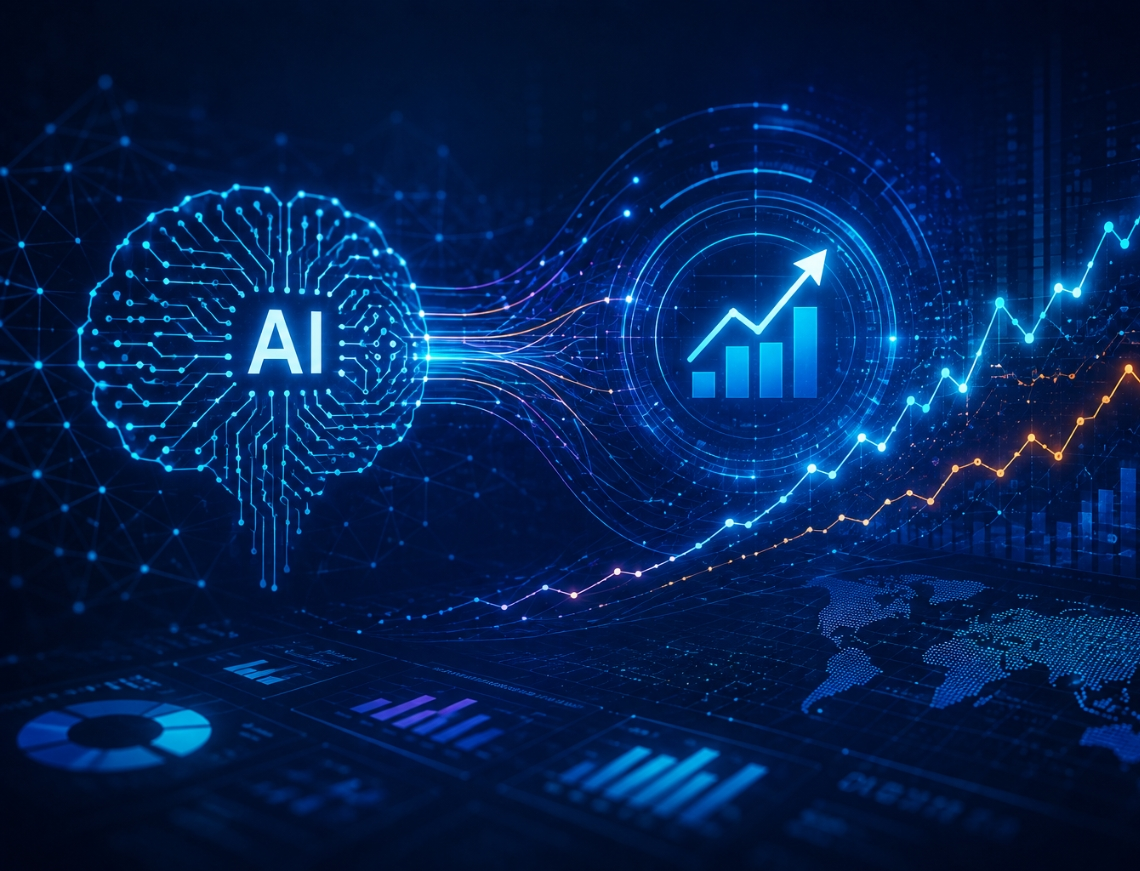
Artificial intelligence predictive analytics combines traditional forecasting methods with AI techniques such as machine learning to spot trends in data and forecast future results. Unlike purely static forecasting approaches, machine-learning systems can incorporate new data through scheduled retraining, online learning, or other model-updating processes.
“AI” and “predictive analytics” are used almost interchangeably in business conversations, but they’re not quite the same thing, and the difference matters more than it might seem. Understanding where one ends and the other begins is the key to understanding why forecasting today looks so different from forecasting a decade ago.
Key Takeaways
- Predictive analytics is the practice of forecasting outcomes; AI, including machine learning, is a broader field that includes tools for building those forecasts.
- Predictive analytics can work with traditional statistics alone; AI becomes valuable at scale, with messy data, or when patterns shift quickly.
- Machine learning can make forecasting more adaptive by letting models retrain or update as new data becomes available.
- AI-powered predictive analytics isn’t automatically more accurate; accuracy depends on the data and the problem.
- The real shift isn’t AI replacing predictive analytics; it’s AI expanding the types of data, patterns, and adaptive modeling approaches predictive systems can use.
What Is Artificial Intelligence Predictive Analytics?
Artificial intelligence predictive analytics refers to forecasting methods that use AI techniques, most commonly machine learning, to identify data trends and predict future outcomes. It sits at the intersection of two related but distinct fields: predictive analytics, the business practice of forecasting, and artificial intelligence, the broader technology that powers that forecasting.
Put simply: predictive analytics asks the question. AI, and machine learning specifically, increasingly helps answer it.
AI vs. Predictive Analytics: Where the Confusion Comes From
The terms get blurred because they overlap heavily in practice, not because they mean the same thing. Predictive analytics is the discipline focused specifically on forecasting future outcomes from data. Artificial intelligence is a much broader field of computer science aimed at solving complex problems generally; machine learning, a subset of AI, is one of the primary tools used to build modern predictive models.
- Predictive analytics existed before modern AI, using regression and time-series statistics.
- A subset of AI called machine learning discovers patterns in data rather than following predetermined rules.
- Most “AI-powered” forecasting tools today are really predictive analytics built on machine learning.
- Not all predictive analytics use AI, and not all AI is used for prediction.
AI vs. Predictive Analytics: Side-by-Side
| Factor | Predictive Analytics | AI/ML-Enabled Predictive Analytics |
| Core purpose | Forecast a specific future outcome | Solve broad, complex problems, including forecasting |
| Methods used | Statistics, regression, historical trend analysis | Machine learning, neural networks, and statistical methods |
| Data types | Primarily structured, historical data | Structured and unstructured data (text, images, behavior) |
| Adaptability | Model retrained manually as patterns shift | Can continuously learn and adapt from new data |
| Relationship | A practice/discipline focused on forecasting | The broader field; ML is a subset used to power predictions |
| Best fit for | Stable trends with clear historical patterns | Complex, messy, or unstructured data at scale |
How Machine Learning Is Actually Changing Forecasting
- From Static to Adaptive Models: Traditional forecasts required manual updates as conditions changed. Machine learning models retrain continuously on new data, adjusting predictions as patterns shift.
- From Structured-Only to Unstructured Data: Classic predictive analytics worked almost exclusively with clean, structured records. AI predictive modeling can incorporate text, images, and behavioral data alongside traditional numbers.
- From Simple Trends to Complex, Non-Linear Patterns: Machine learning can detect subtle, non-linear relationships in data that traditional statistical models often miss entirely.
- From Manual Retesting to Continuous Learning: Older approaches required analysts to retest assumptions manually. AI-powered predictive analytics evaluates and refines itself as new data arrives.
- From Narrow Use Cases to Broader Applications: Because AI generalizes better than traditional statistical models, the same underlying architecture can often adapt to very different forecasting problems.
Real-World Example: Forecasting Beyond the Numbers
Consider a healthcare organization trying to forecast patient readmission risk. Traditional predictive analytics might rely on a handful of structured variables age, diagnosis code, prior admissions to generate a risk score using regression. An AI/ML-enabled predictive system could incorporate additional inputs such as appropriately governed clinical notes and evolving patient history alongside structured variables. Depending on the system architecture, models may also be monitored and periodically retrained as new validated data becomes available.
The practical advantage is not simply “continuous learning.” It is the ability to work with richer data, model more complex relationships, and support more adaptive forecasting pipelines when the use case justifies them.
How Deep Data Insight Builds AI Predictive Models
Deep Data Insight brings over 100 years of combined multi-disciplinary AI and data science experience to predictive modeling projects, with proven platforms already deployed across regulated, data-intensive industries. Rather than treating AI and predictive analytics as separate initiatives, Deep Data Insight builds forecasting systems that combine both statistical rigor with machine learning’s ability to adapt.
- Proven platforms including Eddie (document intelligence), Perc3pt (personality analytics), and the DDI Grouper
- Experience applying AI predictive modeling across healthcare, finance, retail, and other industries
- A discovery-first approach that scopes whether traditional statistics or full AI/ML modeling fits the problem
- Offices in the U.S. and Sri Lanka supporting a global client base
Does your forecasting need traditional predictive analytics or full AI-powered modeling? Request a demo with Deep Data Insight to find out.
The Bottom Line
AI and predictive analytics aren’t competing concepts; predictive analytics is the goal, and AI, particularly machine learning, is increasingly how that goal gets achieved at scale. The businesses getting the most out of forecasting today aren’t choosing one over the other; they’re combining statistical rigor with AI’s ability to learn and adapt continuously. Deep Data Insight builds exactly that kind of system.
FAQs
Is predictive analytics the same as artificial intelligence?
Not exactly. Predictive analytics is the process of predicting future outcomes from historical data. At the same time, artificial intelligence is the broader field of technology that includes machine learning, natural language processing, and other methods, some of which power predictive analytics.
Is predictive analytics a subset of machine learning, or vice versa?
Machine learning is a family of methods used in predictive analytics, while predictive analytics is a broader practice focused on forecasting outcomes. Deep learning is a subset of machine learning. Techniques from natural language processing can also predict text or language data.
Can predictive analytics work without AI or machine learning?
Yes. Predictive analytics can rely on traditional statistical methods like regression and time-series analysis without machine learning. AI and machine learning become valuable when the data is large, messy, unstructured, or changing quickly enough that manual model updates can’t keep up.
Is AI-powered predictive analytics always more accurate than traditional predictive analytics?
No. Accuracy depends on the data and the problem, not just the method. A simple statistical model can perform very well on stable, well-understood trends. At the same time, AI-powered predictive analytics tends to outperform on messy, high-volume, or unstructured data where patterns are harder to detect manually.
What industries benefit most from AI predictive modeling?
Industries with large volumes of complex, fast-changing data, including healthcare, finance, retail, and supply chain, tend to benefit the most from AI predictive modeling, since traditional statistical methods often struggle to keep pace with that scale and complexity.